
Alarm Management in Industrial Control Systems
This article defines alarm management as an operating discipline in industrial control systems. It summarizes foundational principles, references ISA-18.2, and highlights lessons learned from major industrial incidents where alarm system performance affected outcomes.

Highlights
|
An alarm must indicate an abnormal condition and require a timely operator response. If no action is required, the indication should be classified as an alert or status message.
Inadequate alarm performance contributed to disasters like Three Mile Island and BP Texas City. Poorly managed systems reduce effectiveness during critical events.
Alarm management is a continuous lifecycle, not a one-time project. It requires a formal Philosophy and Rationalization to ensure every alarm earns its place.
Why Alarm Management Exists
Alarm management exists to ensure that operators receive actionable information when abnormal conditions require immediate response.In many facilities, control systems are designed, programmed, and commissioned without a formal alarm management strategy. While such systems may function technically, they often fail to support operators during abnormal situations. Alarm overload, poor prioritization, and ambiguous annunciation reduce the effectiveness of alarms precisely when they are most needed.
Industry investigations have repeatedly identified inadequate alarm system performance as a contributing factor in major process incidents. Despite this, alarm management is still frequently treated as a configuration task rather than a governed lifecycle process.
Effective alarm management is not about increasing the number of alarms. It is about controlling alarm quality, relevance, and usability.
Three Mile Island Nuclear Accident (1979)
BP Texas City Refinery Explosion (2005)
According to the report by the U.S. Chemical Safety and Hazard Investigation Board[1], required alarm and instrument functionality checks were not completed prior to startup, and that operators and supervisors were operating under time pressure. In the same report, at some point,
“Supervisor A tells instrument technicians to stop checking the critical alarms because the unit is starting up and there is not enough time to complete the checks”
— US Chemical Safety Board Final Report
This prioritization of schedule over system integrity meant that false and misleading indications went undetected, failing to alert operators as the distillation tower overfilled. In a professional alarm management lifecycle, system "readiness" must be a hard gate; if the alarm system is not fully verified, the introduction of hydrocarbons is an unacceptable risk.
Deepwater Horizon Explosion (2010)
Investigation records from the Bureau of Ocean Energy Management[2] revealed that critical warning systems were intentionally inhibited to avoid disturbing personnel during rest periods, treating the symptom of poor alarm design rather than the underlying cause. When the well escalated into a blowout, the system was physically incapable of providing the timely warning required to save the rig. This reinforces a central principle of technical governance: an alarm should never be suppressed without a formal management-of-change (MOC) process. If an alarm is frequent enough to be considered a nuisance, it requires technical re-rationalization rather than simple inhibition.
The explosion killed 11 workers and resulted in one of the most significant environmental disasters in modern history.
These incidents, among many others, demonstrated a common theme. Operators were not failing due to lack of training or effort. They were operating within alarm systems that were not designed to support human decision making under stress.
What Qualifies as an Alarm
One of the most important concepts in alarm management is understanding what should, and should not, be configured as an alarm. The ISA-18.2 standard[3] defines an alarm as:
“Audible and/or visible means of indicating to the operator an equipment malfunction, process deviation, or abnormal condition requiring a timely response.”
— ISA-18.2
This definition contains two critical requirements:
- The condition must be abnormal
- The condition must require a timely operator response
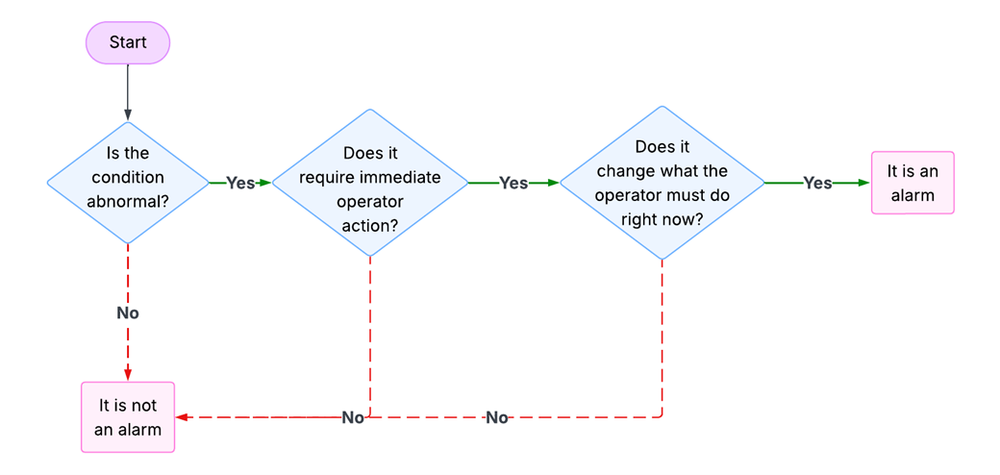
If either requirement is not met, the indication should not be an alarm. It may be better classified as an alert, status indication, or informational message. In a robust technical strategy, we apply this strictly: if the operator’s next action is "continue monitoring," the condition is an alert or a status message, and not an alarm.
If an operator is already responding to another condition, and a second alarm provides no new or actionable information, then that alarm is redundant. Redundant alarms do not improve safety. They compete for attention and increase cognitive load at precisely the wrong time. In practice, this means:
- Informational conditions are not alarms
- Status indications are not alarms
- Conditions that require awareness but no action are not alarms
- Multiple alarms caused by the same underlying event should not all annunciate
An alarm system should guide an operator toward the next correct action. Any annunciation that does not change what the operator must do next weakens the system as a whole.
This distinction is one of the primary reasons alarm rationalization exists. Without disciplined enforcement of this rule, alarm systems inevitably grow into collections of noise rather than tools for decision support. Modern HMI platforms make it deceptively simple to "alarm on everything." However, this creates a high cognitive load that yields diminishing returns on safety. A high-performing system treats operator attention as a finite resource. Every redundant alarm, those that provide no new information or occur simultaneously with a root-cause event, effectively taxes that resource, increasing the risk of a missed critical indicator during a flood.
In our collective experience in the industry, a recurring misconception is the belief that "it doesn't hurt to provide the operator with extra information via an alarm." Technically and operationally, this is a flawed premise. When "extra information" is delivered through the alarm system, it violates the fundamental principle of alarm purity. By diluting the pool of actionable alarms with informational status updates, the system inadvertently trains the operator to subconsciously filter or tune out annunciations. This erosion of trust and increase in cognitive load is exactly what leads to the delayed response times observed in major industrial incidents.
The Role of Alarm Management in Operator Effectiveness
An effective alarm system supports operators rather than distract them. Its purpose is to draw attention only when action is required, and to do so in a clear and unambiguous way. Well managed alarm systems help operators by:
- Reducing alarm rates during normal and abnormal operation
- Clearly distinguishing high consequence alarms from lower priority conditions
- Providing consistent alarm messages and response expectations
- Minimizing, if not eliminating, nuisance, chattering, and stale alarms
When alarm systems are poorly managed, operators often adapt by shelving alarms, ignoring annunciations, or relying on experience rather than the alarm system itself. These coping mechanisms may keep a process running day to day, but they significantly increase risk during abnormal events.
Alarm Management Requires Ongoing Governance
The ISA-18.2 standard defines a formal alarm management lifecycle to manage this evolution. The structure and application of this lifecycle are discussed in detail in The ISA-18.2 Alarm Management Lifecycle[4] article.
Contanct our experts at Stellaro Technologies to discuss how we can work together to optimize your alarm system.
References
U.S. Chemical Safety and Hazard Investigation Board (CSB). (2007). Investigation Report: Refinery Explosion and Fire, BP Texas City, Texas View the Report
Bureau of Safety and Environmental Enforcement (BSEE). (2011). Deepwater Horizon Joint Investigation Team Final Report. U.S. Department of the Interior. View the Report
International Society of Automation (ISA). (2016). ANSI/ISA-18.2-2016, Management of Alarm Systems for the Process Industries. [Technical Standard]. View ISA Page
Note: Requires ISA membership to view the standardStellaro Technologies. (2026). The ISA-18.2 Alarm Management Lifecycle [Technical Article]. View Article